Types of Pearls – Natural, Cultured & Beyond
Pearls make up some of the most sought-after jewellery across the world – as has been the case for hundreds of years. But there isn’t just one type of pearl. There is a whole array of different pearl types, which is part of what makes them so special.
This site is dedicated to guiding you through those different types, along with some background context as to why there are so many varieties…

Behind the pearl types
There are many different types of pearl, some rarer than others. Before we start differentiating between them lets first understand how pearls are born. Put simply, pearls are the product of the act of self-preservation by a mollusc. In other words, the creation of a pearl is caused by the protective reaction of an oyster or mussel to the accidental or deliberate introduction of a foreign body into its organism.
This reaction starts by the mollusc covering the intruder with epithelial cells which will form a pearl sac around the intruder, which in turn deposits concentric layers of nacre that surround the offending object and, layer by layer, slowly form the pearl. If the mollusc does not react in this way, it will die.
Different types of pearls
Now onto the main topic – what are the different types of pearls? Below you’ll find an introduction to the two main subcategories of pearl – natural and cultured – followed by a wide selection of the different kinds of pearls and what sets them apart.

Natural vs cultured pearls
On the exterior, there is no difference between a natural pearl and a cultured pearl. The difference arises from the fact that a natural pearl is formed accidentally and without any human intervention, whereas a cultured pearl is started by the introduction of an irritant by man, after which the process is natural, continued solely by the living mollusc protecting itself from that human-introduced irritant.
A classification of the different types of pearl can be seen opposite, with their position in relation to all other pearls.
Natural pearls and their types
The term natural pearl refers to the fact that the pearl is formed accidentally, without any human intervention. For hundreds of years, this was the only type of pearl available. That was, before the development of the Mise-Nishikawa agreement and subsequent work by Kokichi Mikimoto to create a cultured alternative.
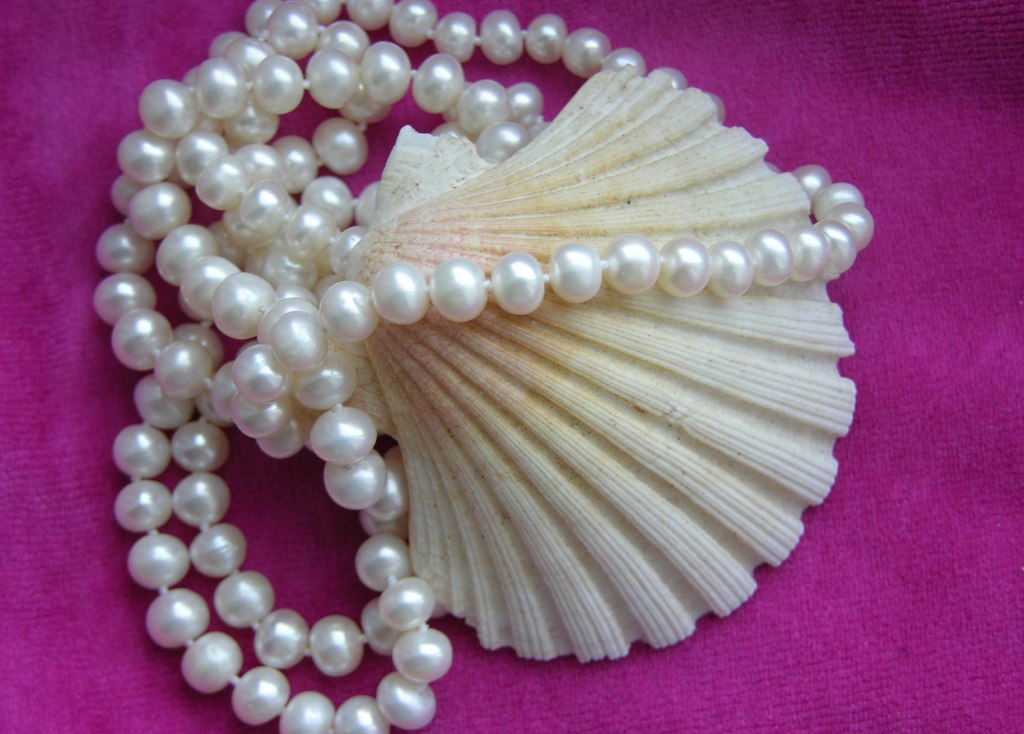
Natural seawater pearls or oyster pearls
These pearls occur when a piece of shell, coral, bone or a large piece of grit hooks into the flesh of the oyster. It breaks the surface of the epithelial cells and carries with it epithelial- or nacre-producing cells. The oyster tries to expel the intruder but if it is unable to dislodge the irritant, this foreign body will start the formation of a pearl.
A grain of sand is hardly ever involved in the production of a natural pearl as the oyster lives in sand and can easily expel it. Elisabeth Strack, an eminent pearl specialist of our day, discovered another way in which a natural pearl can be formed, as shown below. If the epithelial-cell covering of the mantle is broken and these crucial nacre-making cells travel as a group into the mantle, this in turn will form a pearl sac and a natural pearl will be born.
The most famous example of a seawater natural pearl is La Peregrina – a drop shape natural pearl which was discovered in the Americas. It was given by Phillip II of Spain to Mary Tudor as a wedding gift. On her death, it returned to Spain and was taken to France. Prince Louis Napoleon sold it to the Marquis of Abercorn in 1837. The Marquis’ son then drilled La Peregrina and recorded its exact weight – 10.192 grams or 50 carats plus.
Subsequently, in 1969, Richard Burton bought Elizabeth Taylor a pearl reputed to be the Peregrina for $37,000. Its authenticity was challenged, but thanks to the exact record from the Marquis’ son, it was confirmed to be the famous pearl. It was recently sold again by Christies Auction House, for 10 million dollars plus saleroom fees, which goes to show what celebrity status can do for a pearl combined with a market hungry for status.
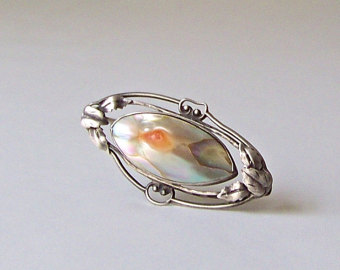
Natural oyster blister pearls
This type of pearl can be started by:
- A parasite, like a crab, that settles in the shell
- A worm that drills through the oyster shell and dies
- Larva that obstructs a duct within the shell, becomes infected, and is then covered with the epithelial cells that protect the mollusc
These pearls have a flat surface on one side because they have been grown on the inside of the shell.
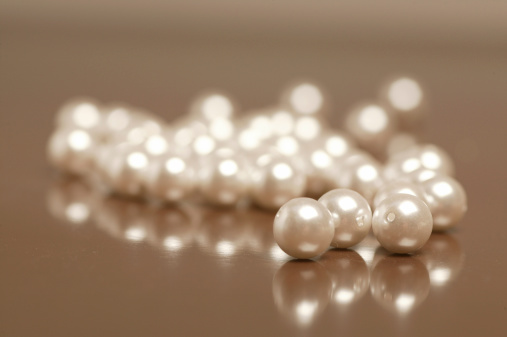
Natural oyster seed pearls
These pearls are 2mm or less in diameter. In this category we also find dust pearls which, as the name implies, are tiny and are considered too small for jewellery use.
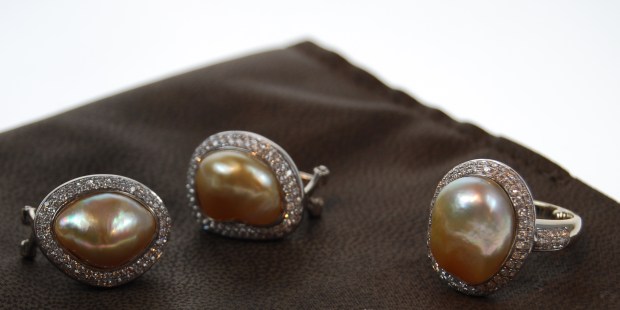
Keshi pearl
The Keshi is a natural pearl which occurs within a cultured oyster host – in a cultured pearl farm. Alternatively, when the graft and nucleus in a cultured pearl fail to attach to each other, the oyster rejects the nucleus and the graft tissue forms a pearl sac and secretes nacre layers.
The term Keshi in Japanese means seed. These pearls are almost always baroque in shape. Although a Keshi could well be a natural pearl in composition, it must always be described as Keshi, because it grows in a cultured oyster.

Natural freshwater pearl
The term natural freshwater pearl refers to the freshwater pearl being formed accidentally without any human intervention in a pearl bearing mussel or mulette. Famous natural pearls have come from Scottish, European and American rivers, like the Queen Pearl and the Abernethy Pearl.
Natural freshwater pearls are formed when a small stone or a calcareous concretion lodges in the pearl bearing mussel and starts the formation of a pearl. These pearls have rounded surfaces although they can be of many different shapes. Their colours can be among others white, soft pink, mauve, heather, brown and pale grey.

Natural freshwater blister pearls
This specific type of pearl is accidentally formed in a pearl-bearing mussel. They have a flat surface on one side of the pearl.

Natural freshwater seed pearls
These pearls are 2mm in diameter or less and have occurred accidentally in a pearl-bearing mussel.
What is a cultured pearl?
The term cultured pearl means a technician has implanted an irritant into a pearl-bearing mollusc. This irritant must include a graft made from epithelial cells found in the mantle tissue of a donor mollusc. The graft forms a pearl sac and within this sac the mollusc will secrete layers of nacre to cover the irritant.
It is important to bear in mind that after the irritant has been introduced, the process is continued solely by the metabolism of the living mollusc (a purely natural process). The pearl farmer has no control over what these pearl bearing molluscs will produce in size, shape, colour, or even whether they will produce a pearl at all. The result? Despite being ‘cultured’, each pearl is truly individual.

Cultured oyster pearls
This type of pearl begins when a technician implants a nucleus into the pearl bearing oyster, made of mother of pearl or resin, with an epithelial cell graft that has come from the mantle tissue of a donor oyster. The graft covers the nucleus, forming a pearl sac which is rather like a placenta. As above, this sac secretes layers of nacre to cover the nucleus that it is enveloping. Layer by layer, it eventually forms a pearl with the nucleus turning freely within the pearl sac.
Because these pearls have a nucleus as an irritant, they are termed nucleated. Cultured oyster pearls are normally harvested in the colder months when the nacre layers are thinner, hence the lustre will usually be at its best. Generally, each oyster produces only one pearl, which means the oysters are looked after very carefully in a farm. Predators are kept at bay, and each oyster is checked and scrubbed at least three times a year.
The following grid gives an idea of the success rate of oyster pearl cultivation, Out of 1,000 cultured oyster hosts:
- 500 (50%) die or eject the nucleus.
- 250 (25%) produce pearls of marketable quality.
- 200 (20%) are rejected pearls.
- Only 50 (5%) produce top quality pearls.
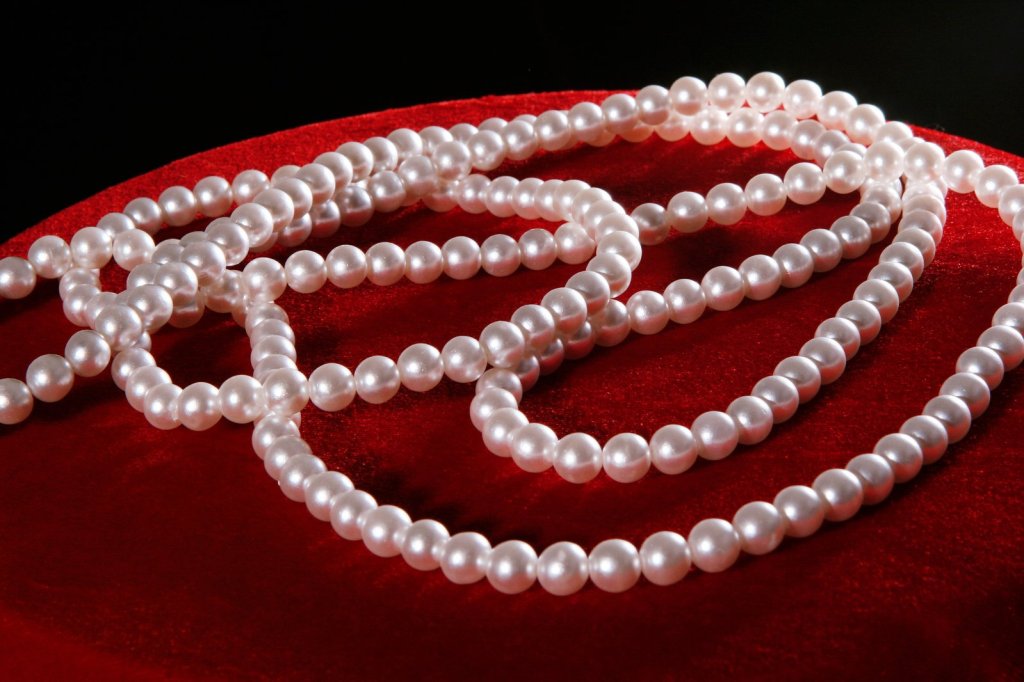
Cultured south sea pearls
These pearls are mainly 9-16mm in diameter, although they can be well over 20mm. The nucleus is a mother of pearl bead and the nacre can start from 1mm thick up to its usual size of 2.5mm thick. South Sea pearls are produced in white-lipped, silver-lipped and gold-lipped oysters that inhabit the waters of Australia, New Guinea, the Philippines, Indonesia and Burma.
The shell hosts can be as large as 12 inches across and produce pearls whose nacre is coloured according to the mother of pearl coloration of its hosts’ shell. So, white- and silver-lipped oysters birth pearls that are mainly white in colour with a range of overtones from silver to pale pink. On the other hand, gold-lipped oysters will create pearls that go from a light gold hue to a deep orange-gold hue.

Cultured Tahitian pearls
Cultured Tahitian pearls are mainly 8-18mm in diameter, although they can grow to 21mm. The nucleus is a resin or mother of pearl bead, with the thickness of the nacre starting at 0.9mm and usually being around 2.5mm. They grow in the black-lipped oyster, which produces black pigment, and are found in the surrounding area of the archipelago of French Polynesia, Panama and Mexico.
Their colours are naturally dark and range from grey to black and peacock green to aubergine. However, they can sometimes be very light in colour from white to yellow and pink, all of which have grey overtones.
Cultured blister pearls
Ranging in size from 4-10mm, these pearls have been cultured on the inside of the shell. Consequently, they have a small flat area where they were attached to the shell (shown in the image below). Blister pearls are mainly used for earrings and brooches.

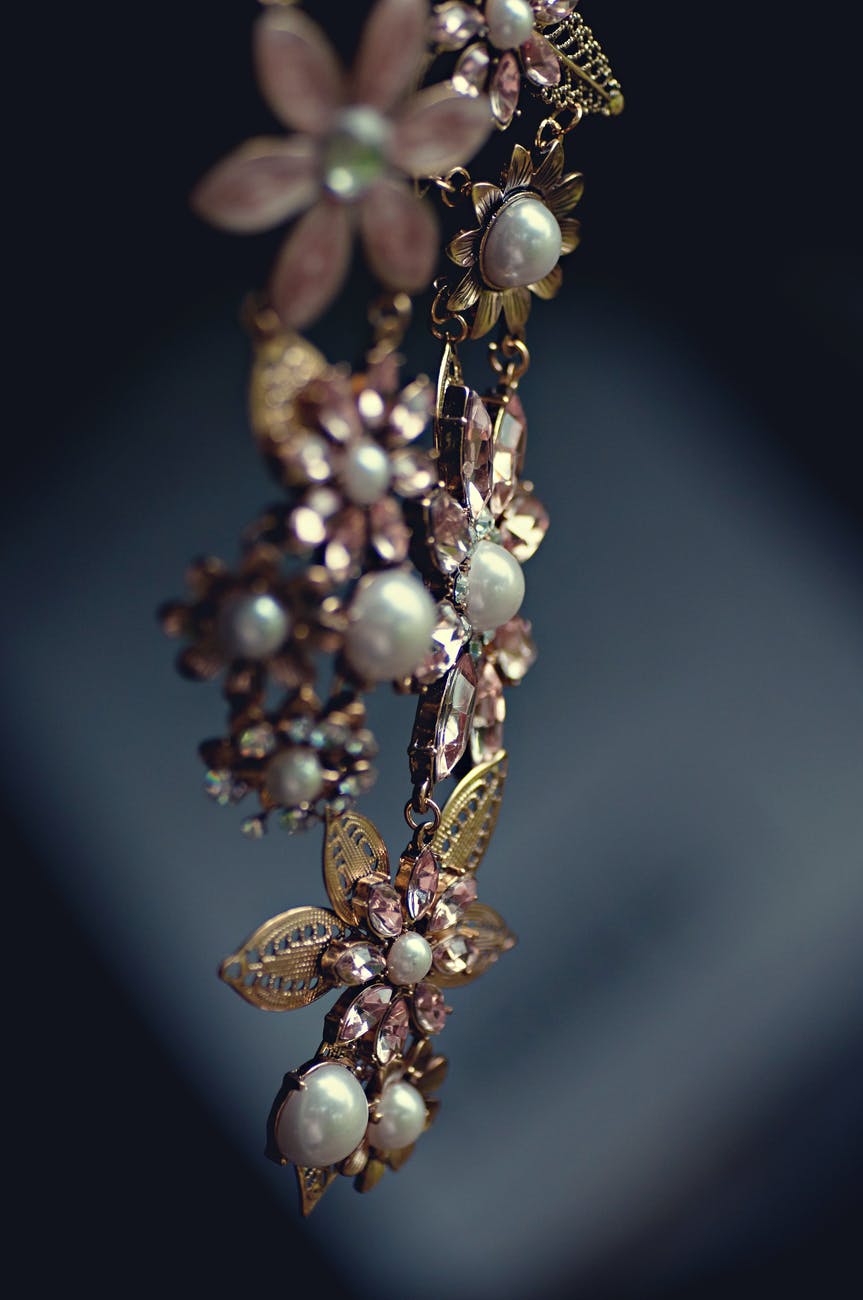
Cultured composite or Mabe pearls
Composite pearls are normally found in sizes from 11mm to 17mm. Also known as Mabe pearls, they are cultivated by attaching a mother of pearl half sphere to the shell. Layers of nacre build up on this half sphere, which is later cut out of the shell. The original dome shaper is removed and the fragile empty half sphere is cleaned with diluted hydrochloric acid, then filled in with resin and a mother of pearl half bead and stopper.
The amount of human interference that goes into strengthening the Mabe pearl gives rise to its other description of ‘composite’. The nacre layers in a Mabe pearl are horizontal, as found in mother of pearl, and not concentric, as in a true pearl (shown below). Mabe pearls are used for earrings and brooches or pins.


Cultured oyster Akoya pearls
Ranging in size from 3mm to 10mm, Akoya pearls start life when a technician implants a spherical resin or mother of pearl nucleus into the pearl bearing oyster alongside an epithelial cell graft that has come from the mantle tissue of a donor oyster. The graft forms a pearl sac around the resin or mother of pearl implant, within which layers of nacre are secreted to cover the nucleus.
Akoya pearl bearing oysters must be three years old before they are able to host a pearl successfully and their life expectancy is only seven years. Mikimoto, who was the first to cultivate pearls extensively, recommended that the irritant should be left in the host oyster for three years.
At present the accepted time is 1 ½ years, which results in a good 0.5mm coating of nacre, as seen in the halved pearl pictured above. Sadly, economic pressures mean that in some cases the irritant is left in the oyster for only six months, leaving a nacre coat so thin that the pearl blinks when rolled on a flat white surface. That essentially means you can see the mother of pearl bead within the pearl.
The nacre of Akoya pearl-bearing oysters is naturally found in shades of pale bluish grey. Hence, the pearls from these oysters are normally born in pale blue, deep blue or pale blue/grey colours. However, these colours are rarely found for sale in the market. This is because, for decades, Akoya pearls have been bleached and/or pinked to render them the pale colours that we have grown used to seeing and revering.
Bear in mind that the first cultured Akoya pearls were considered ‘fake natural pearls’ and had to imitate natural pearls as best they could by imitating the colours normally found in natural pearls which ranged from white with pink overtones to pale gold pearls. Nowadays, cultured Akoya pearls are generally found in all shades of white, from very pure white through to pale pink and golden tones.
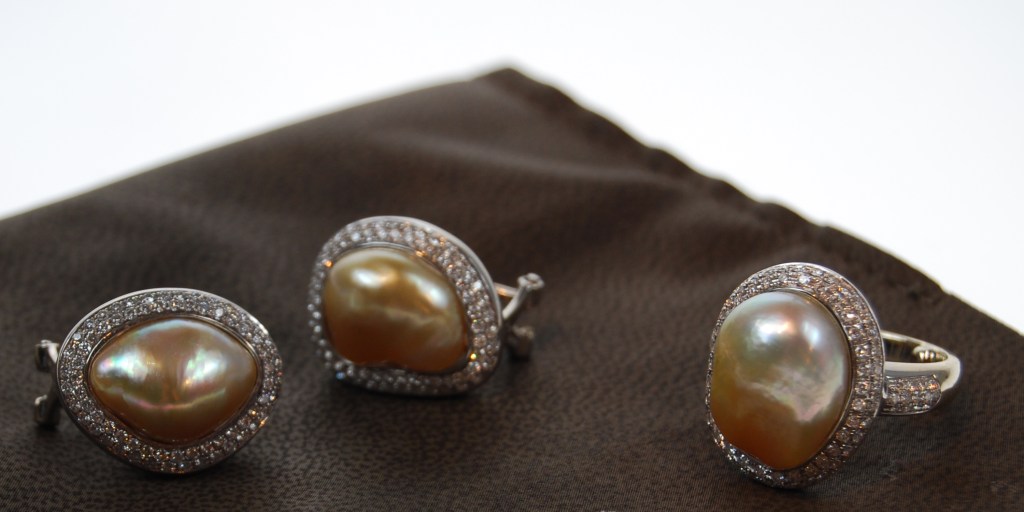
Keshi
Included in both the natural and cultured pearl categories, the Keshi is a natural pearl which occurs within a cultured oyster host or when the graft and nucleus in a cultured pearl fail to attach to each other.
As outlined earlier, the oyster rejects the nucleus but retains the graft tissue which forms a pearl sac. The graft tissue then begins secreting nacre layers to form a pearl. These pearls are almost always baroque in shape. Although a Keshi could well be a natural pearl in composition, it must always be described as Keshi because it grows in a cultured oyster.

Cultured oyster seed pearls
This type of pearl is typically 2mm in diameter or less, and has grown in a cultured pearl-bearing oyster.
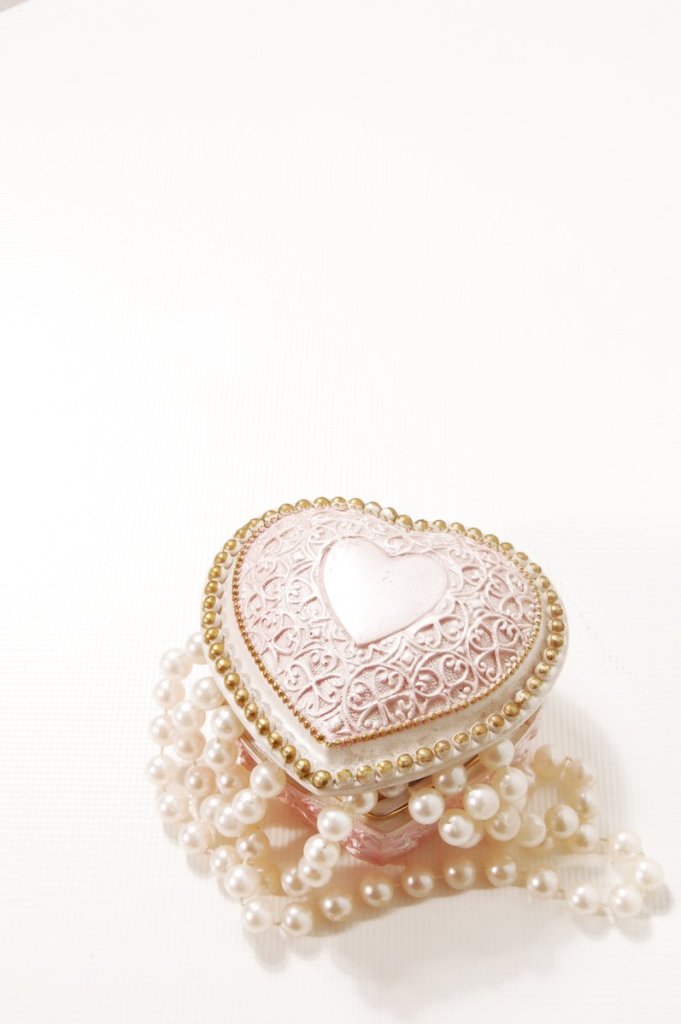
Freshwater cultured pearls
Freshwater cultured pearls are produced in a mussel as opposed to an oyster. The production of nacre is triggered by the insertion of a piece of mantle tissue that contains epithelial cells from a donor mussel. The graft forms a pearl sac which in turn starts the nacre production.
In general, these pearls have no bead as a nucleus and are therefore termed non-nucleated. When we x-ray a freshwater pearl, it shows solid nacre layers and a very small empty cavity at the centre. This cavity originally held the irritant piece of mantle, which has by now dried up, decomposed and disappeared.
In recent years, some cultured freshwater pearls that have a nucleus have come onto the market – which are termed ‘potato pearls’. To form these almost round freshwater pearls, the farmers have harvested the pearls halfway through their growth term. The harvested pearl is placed in a tumbling machine to render it spherical.
This rounded freshwater pearl nucleus is re-inserted into the mussel, which accepts this pearl bead as its own production and proceeds to coat it with more layers of nacre in an almost spherical shape – very akin to a new potato shape, hence their very unflattering commercial name.
Freshwater pearls are found under the thick mantle of either side of the shell and not in the main body of the mussel. Their creation is therefore less intrusive to the creature. While some mussels live to be over a hundred years old, the mussels most widely used today for culturing purposes have a life expectancy of 30 years. They await their third birthday before they can host pearl production and are then able to produce up to three generations of pearls before being discarded at the age of 18. Their shells are returned to the water to provide calcium for future generations.
The size of freshwater pearls is purely determined by the amount of time that the pearls spend in the water. The longer they stay in the water, the bigger the pearl will become. Each mussel can produce 10 to 40 pearls each generation. During the harvest, all pearls are removed from the pearl sac, the pearl technicians leave the sac in place so that the oyster can heal itself and go onto produce future generations of pearls.
The main producer of cultured freshwater pearls is China, as it has the technology to produce and improve pearl production, and the labour costs are very low.

Cultured river or Kurasu pearls
These pearls, cultured in the Kurasu mussel, are shaped like a grain of rice with a surface of wrinkled appearance. They were extensively cultured in China and flooded the market in the 1980s. Otherwise known as ‘Rice Crispy pearl’, they were normally found in white or cream shades, but at one point they were dyed in bright, sometimes almost fluorescent, colours.
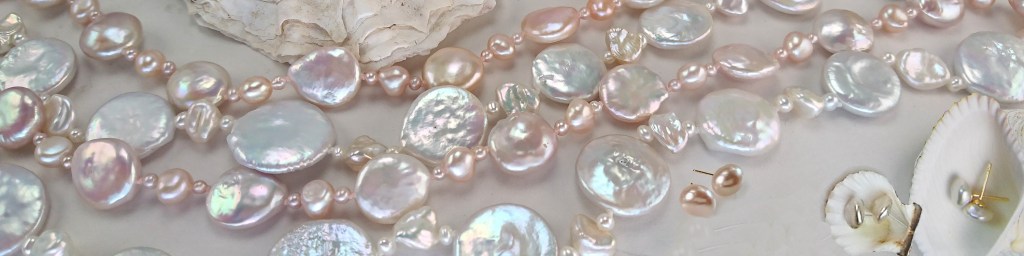
Cultured lake or Sankaku pearls
Also known as Biwa pearls, this type of pearl was first cultured in Lake Biwa, Japan, in the 1930s. Their size depends on how long the pearl has been growing in the water. The characteristic smooth skin and deep lustre of Biwa pearls makes them instantly appealing to the eye. They come in a variety of rich natural colours that range from white, cream and apricot to heather, mauve and pale pink or even brown/copper to pale grey.
Biwa pearls also come in a variety of shapes as the irritant is a piece of tissue that can be cut into several different forms. They range from long strips, to round flat beads, from oval pearls to fantastic shapes that look like crosses, dogs and mythical dragons. Recently, it has even been possible to find almost perfectly round spheres. You can also find these pearls in a variety of dark shades, having been treated or dyed in such a way that the colour is permanent.
Cultured freshwater seed pearls
Finally, cultured freshwater seed pearls are found alongside other freshwater pearls in cultured freshwater mussels. They are 2mm or less in diameter.
Learn more about the types of pearls and their incredible origins
For more information about the types of pearl and to shop for pearl jewellery, look no further than Coleman Douglas Pearls. pearls.co.uk is the perfect destination for remarkable resources on pearls.
 Types of Pearls